

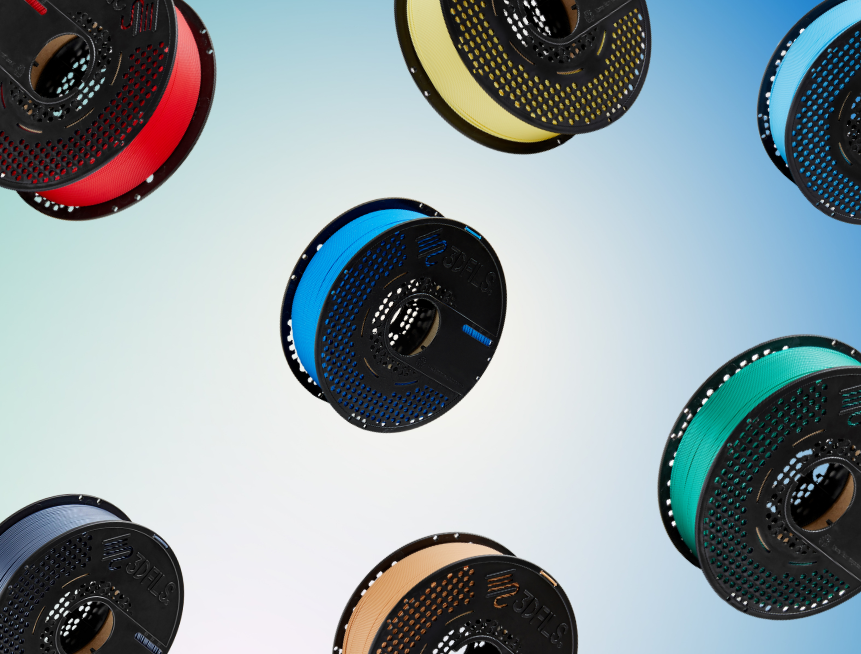


What is PLA Silk and when to choose it
3DFils PLA Silk is a PLA filament with a shiny, silky finish, also known as silk PLA. It contains additives that reflect light across the part, creating that silk-like effect with metallic sparkles that conceals layer lines and produces visually cleaner surfaces. We choose it when the visual appearance of the finished part is important, not its mechanical strength.
The most common question we get about this filament is whether it prints differently from regular PLA. The short answer is no: it behaves practically the same, with similar temperatures and ease of use. It works on any FDM 3D printer, including high-speed printers like Bambu Lab X1, P1, A1, and Creality K1, and does not require a hardened nozzle or an enclosed chamber. What changes is the result: where standard PLA leaves visible layer lines, Silk conceals them, and the part has a silk or polished metal-like finish.
What it's used for: real-world applications
These are the uses we see most often in customer orders and technical support:
- Cosplay. Accessories, decorative armor, details that catch reflections. Metallic tones (gold, silver, red, purple) are the most in demand.
- 3D jewelry and costume jewelry: pendants, bracelets, earrings with a polished metal look.
- Decorative figures and visual prototypes where finish matters more than function.
- Modeling and scale models with a premium effect, especially details that need to shine.
- Personalized gifts and design objects: the silk effect makes the piece not look 3D printed.
- Commercial models and product demonstrators for trade shows or storefronts.
We do not recommend PLA Silk for functional parts under stress (gears, load-bearing supports, tools). For those, standard PLA or PETG is better. It is also advisable to avoid it when sanding is needed to correct defects, because sanding destroys the satin effect.
PLA Silk vs. other PLA variants
As a quick reference for choosing among our PLA variants:
- Standard PLA. Uniform matte finish and better mechanical resistance. This is the default filament when function is what matters.
- PLA Silk. Shiny, silky finish with metallic sparkles. Conceals layer lines. For parts that need to reflect light.
- Marble PLA. Matte with natural stone-like veins. Also conceals layers. For vases, sculptures, and pieces with a natural stone look.
- Galaxy PLA. Glittering particles with a galactic depth effect. More visually spectacular than Silk. Cosplay and wow-factor pieces.
How to print PLA Silk: recommended settings
PLA Silk filament is printed with the same parameters as standard PLA, but there are two settings that make the difference between a correct finish and a truly shiny finish.
The first is speed. Although the material supports up to 300 mm/s on high-speed printers, the satin effect develops best at moderate speeds, between 40 and 60 mm/s. If your priority is the finish, print at 50 mm/s. If your priority is to finish quickly, go up to 200-300 mm/s, assuming a slight loss of shine. We see this a lot with Bambu Lab customers: they take advantage of the printer's speed and then wonder why the Silk doesn't shine as expected. The answer is usually to reduce the speed.
The second is ventilation. It should be at 100% from the second layer onwards. If the ventilation is low, the silk additive burns and the part loses its characteristic shine. The optimal nozzle temperature is 215 °C; if the part comes out matte, increase it by 5 °C at a time until you find the point where your printer produces maximum shine.
The rest of the parameters are standard PLA:
- Bed temperature: 55 °C (range 50-60 °C, optional on some printers).
- Retraction: standard settings for your printer for PLA.
- Nozzle: 0.4 mm brass. Hardened is not necessary.
- Does not require an enclosed chamber.
Compatible with all FDM 3D printers on the market: Bambu Lab X1, P1 and A1, Creality K1 and Ender, Prusa MK4 and MINI, Anycubic Kobra, Ultimaker. If your printer already prints standard PLA, it will print PLA Silk without modifications.
Finishing and post-processing
PLA Silk can be sanded, but it should be noted that sanding destroys the satin effect in the sanded area. If you need to eliminate layer lines, it is best to calibrate the printer well before printing instead of correcting afterward. For painting, it works the same as any PLA with a specific primer for plastics, although painting eliminates the main reason for choosing Silk: the visual finish is already in the material.
If you want to enhance the shine of the finished part, a clear glossy varnish works well. Supports come off without marking the part if the separation distance in the slicer is adjusted correctly.
A note on large spools
Something to be aware of for parts that require more than one spool: the gloss effect may vary slightly between different spools, even if they are from the same batch. This is common to all Silk on the market, it is not specific to 3DFils. For large parts, we recommend verifying that you have enough material before starting the print, or printing in segments that allow for splicing in non-visible areas.
Our technical commitment
What we control in each spool:
- Diameter 1.75 mm with a tolerance of less than ±0.03 mm, no ovality.
- European raw material of vegetable origin (corn starch).
- Batch-to-batch pigmentation control to ensure color repeatability between purchases.
- Clean winding without tangles.
- Real stock in warehouse and shipping within 24-48 hours on the peninsula.
If you have any doubts about whether PLA Silk is the filament you need for your project, please contact us.